



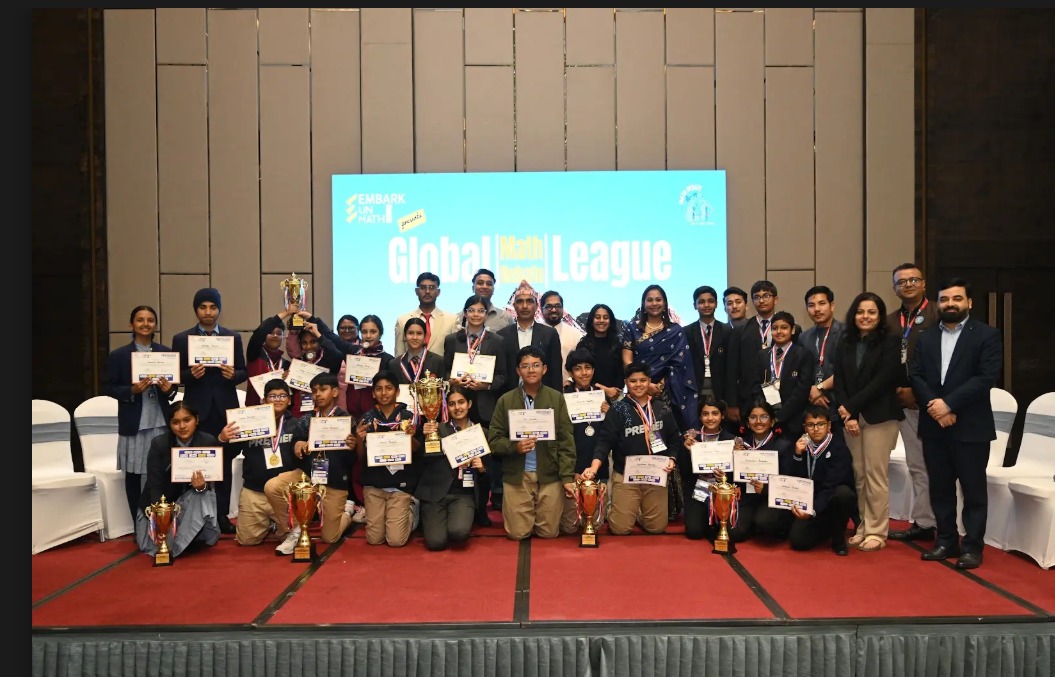
Kathmandu: Nepal’s academic competition landscape has crossed a significant milestone as the Global Math Debate League successfully concluded its National Round at The Plaza, Lalitpur. What began as a
multi-city rollout across Jhapa, Biratnagar, Chitwan, Lumbini, Pokhara, and Kathmandu has now matured
into a structured national academic circuit, positioning itself as the country’s first platform dedicated to debating mathematics rather than merely solving it.
The initiative, led by education organization Embark UnMath, is reengineering how mathematics is experienced in schools. Instead of rewarding speed and procedural accuracy alone, the league compels
students to justify assumptions, interrogate logic, and defend arguments in real time. The format is closer to academic peer review than conventional examinations.
From Regional Rollout to National Convergence
With all regional rounds successfully concluded, the National Round brought together top-performing
teams from across Jhapa, Biratnagar, Chitwan, Pokhara, and Butwal. A total of 13 teams in the Alpha Category and 14 teams in the Beta Category qualified for the championship stage, reflecting strong national traction and competitive depth.
Challenging the Memorization Model
For decades, Nepal’s education system has prioritized final answers. The Global Math Debate League prioritizes justification.
Participants build structured cases around mathematical claims, present reasoned arguments, and engage in rebuttal rounds under panel evaluation. Judges assess reasoning depth, coherence, adaptability, and collaborative intelligence. These capabilities align more closely with higher education and real-world problem-solving than traditional classroom testing.
The model directly addresses a systemic issue. Students can compute, but often struggle to articulate
reasoning. The debate framework exposes conceptual gaps while strengthening intellectual ownership.
National Champions, Alpha Category
1st Place: Premier International IB Continuum School
Manav Sanghai
Aansh Roongta
Vivaan Agrawal
2nd Place: Kathmandu Pragya Kunja School
Aadhya Thapa Anupreksha Khatiwada Vidheyak Dhakal
3rd Place: NAMI International School
Shreyasi Acharya
Kabya Shrivastava
Akshaj Parajuli
National Champions, Beta Category
1st Place: New Horizon English Boarding Secondary School
Prastuti Nepal
Samragi Belbase
Prekshya Khanal
2nd Place: Premier International IB Continuum School
Aayushman Agrawal
Aagaman Gautam
Osin Shrestha
3rd Place: RAI School
Vipul Dubey
Gauransh Tyagi
Ojas Jha
3rd Place: Kumudini Homes Secondary School
Sanskriti Gairhe
Aaditya Khattri
Pratistha K.C
Judges noted that winning teams distinguished themselves not merely through correctness, but through
adaptability. They refined arguments under scrutiny instead of repeating rehearsed logic.
Institutional Partnerships Powering the League
The National Round was executed with a strong multi-stakeholder ecosystem:
Britannica Inc. as Research and Skill-Tech Partner
Foodmandu as Food Delivery Partner
TBG Nepal as Fraction Sponsor
Lumbini World School and Kumudini Homes Secondary School as Co-Organizing Partners
Supported by Educase and Lab of Future
This partnership architecture demonstrates that schools and corporate stakeholders can operate as
implementation allies rather than symbolic sponsors. It offers a scalable model for future academic
circuits.
A Structural Shift in Assessment Culture
The significance of the Global Math Debate League lies not in medals but in methodology. It shifts
mathematics from silent computation to public reasoning. If replicated at scale, such formats could
accelerate reasoning-based assessment practices without waiting for systemic policy reform.
The national rollout has validated the concept. The next phase is institutional integration.
The real benchmark going forward is straightforward. Not whether students can calculate, but whether
they can defend their thinking under pressure.
The league is betting that future education and future leadership will demand both.

Comment